Dedicated to capturing Harlow, in pictures...

Friday, 3 October 2025

Great Plumtree flats

 This mornings walk brought us round past the Great Plumtree flats - a building that I’d looked at before and thought I just look at in more detail, but had then completely forgotten about. It is definitely deserving of a second look though… 


Ignore the bins - buildings like this were far nicer to photograph back in the days of the big metal Palladin bins stashed away in the communal bin store, alas, the local bin men complained about having to lug them about…now they complain instead about having it make many more trips to and from the bin lorry with the wheelie bins, a case of “be careful what you wish for” perhaps! 

Anyway, above there is half of the front face looking into the road, with Stort Tower overlooking it to the right. Tricky to know where to start - the lovely brickwork perhaps - I think the contrasting top section has always been there, but it almost looks like a later addition as one might see on top of a Leslie Green tube station in London. Then there is a the beautiful curved crittall windows on the stairwell - the ridged uprights to each side mirror the shaping on the balconies of the tower behind. 

The recessed balconies originally present on the first floor are now mostly filled in - with just the one still present on this side. You get the impression that a lot of folk now use them as little utility rooms, or enclosed verandas. 


When you step around to the other side of the building things step up a notch with a beautiful double-curve on a second attached longer block -  on this side too there is evidence of the now filled-in recessed balconies, and more of those tall curvy crittall windowed stairwells - such a refreshing change from the dark stairwells so often a feature of this sort of building. 


The walk-through space under the building leads to a large green space with almost a patio area adjacent to the flats - some people have placed garden furniture here, and some of the ground floor flats clearly cultivate a small area as effectively their own little garden too, nice to see communal green space being well used! The walk through area also has the original “pram cupboards” still visible too - although whether these are still used by any of the flats it’s difficult to say. 


These little cupboards would have been present in all the flats originally built in the construction of the new town - the planners were well aware that young families in flats didn’t have the space to store the substantial sized prams that most mums favoured at the time, and so took steps to ensure that the facility was there to keep them safe. 

All in all this block stands out as an absolute gem - and it’s a delight to see that here at least the council haven’t trampled over the original features in the way they have elsewhere. That can probably be put down to the Mark Hall North area where these flats sit being in a conservation area - hallelujah for that! 


Monday, 29 January 2024

Old, new, old again…

 A little wander at the weekend from the old town, into the very early parts of the new town, and ending up in Newhall - didn’t feel tempted to take any more pics of that though! 


North Lodge was one of the old entry points to the Mark Hall Estate as I understand it - it can be found down at the bottom of town adjacent to the Netteswell Road walking and cycle track and the road end at Stackfield, and is well worth a look (check out the amazing chimneys) but be respectful as people do live there! 

From there I walked through Park Hill (taking note of the lovely Oddfellows Terrace) before turning left along Broadway Avenue - with its classic 1930’s semis lining the avenue each side it looked rather fine in the sunshine. A bit of a wiggle at the end brought me into Jocelyns- and an intriguing glimpse of a view… 


Sure enough, the thoughtful approach that was taken with the original build of the New Town was in evidence here as behind me was a low-rise flat block - even the first floor here must have amazing views (there is no ground floor flats as far as I could see with that being given over to garages and storage sheds)  and the top floor must be able to see for miles. The architect here also took the “view through” approach that we also see elsewhere (The Chantry, I think?) with this walkway underneath the flats…


You can see how it allows a view through to the houses and the hill below. The intention of these was to “frame” particular views, although this one is slightly off the mark perhaps with the houses in place! 

Via Station road and back in to the old town proper - and a couple of interesting plaques with something in common…


The first on the Victoria Hall Theatre, the second on the wall of the building it refers to - the link of course being the first and second World Wars. 

From there into one of my favourite streets in the town - Bury Road. Such a complete mosh mash of building styles - it really is worth a stroll if you’re not familiar with it. A couple of my favourites here (although the next time I walk along there I will probably choose two completely different favourites!) 


The red brick house doesn’t seem to have a name - fairly unusual for the larger properties along here - while the yellow brick terraces are called Kimberley Terrace (nearest the camera) and Colenso Terrace and are dated at 1900 and 1901 respectively.  I particularly like the thin metal railings round the front gardens - giving an impression of the “open fronts” which were such a feature of the New Town. Colenso Terrace also provides us with a further link to WW1 as sadly in early 1917 in the space of just a few weeks, the sons of both no 1 & no 4 were killed in action. First A E Seymour on February 17th, then Herbert Clements - on March 26th. 


Robyn


Wednesday, 13 January 2021

Newhall...


Hanley Lane, Newhall 

Can anyone spot the glaring omission from the road layout above? The one that at this point in time, when we’ve for some time been told we should be reducing reliance on our mostly combustion engined cars for environmental reasons, and turn instead to walking more? Even more specifically at this precise point in time in fact - when under lockdown rules it’s being encouraged to exercise from home...?

Yes - pavements. This road is part of the “North Chase” development - one of the newer parts of Newhall - in fact Google Streetview doesn’t currently show the houses that you see pictured above. Imagine being a family with children living there - your 8 year old wants to run up the road (in non-Covid times, obviously) to go and play with his friend. It’s only a short distance, you can watch him all the way,  but you can’t allow him to go unaccompanied because as soon as he’s outside the door, he’s got to share his route with traffic ranging from delivery drivers looking harder at their satnav than the road, the dustcart, older kids on bikes racing each other, and the deliveroo and similar riders on their mopeds who are on a time limit to deliver next doors pizza while it’s still hot... 

Harlow New Town was planned so carefully to ensure that it was safe for pedestrians - indeed far MORE geared up to pedestrians than many other places in the U.K. Newhall is letting the side down - this road is far from the only recently built part of this development without infrastructure to suit those on foot, or allowing children to play outside on the streets. You have to question why Harlow Council gave permission for this to happen! 

Monday, 21 December 2020

Where it all began...

 1949 - and construction begins on the first 120 permanent houses of the New Town we now know as Harlow. Chippingfield - to the south of the original village of Harlow - now Old Harlow. 


The first houses were tenanted by employees of the Development Corporation and many of the tradesmen brought in to construct the new town, and their families. It must have been very strange for their wives in particular - having come from places like Walthamstow and a Tottenham in London, areas which would at the time have had an infrastructure that they knew and house styles that were familiar - in the new town neither of these things applied.


Not only were shops more distant, and initially fewer than the new residents were used to. The houses too - the traditional London terrace build of the time would have seen a sitting room at the front, looking into the street, with living/dining room behind and the kitchen behind that. The toilet would likely have been either directly adjoining the kitchen, via the back door, or in a building across the yard. The designers of the new houses favoured kitchens at the front, theoretically allowing the “modern housewife” to feel like she was part of the community even whilst going about her day. In some cases the interior layout would have also been far more open plan than these families were used to also. 


Chippingfield today is a pleasant area, surprisingly quiet considering it’s proximity to Gilden Way. Many of the original features of the estate remain - the “open fronts” are far more universally maintained than in many areas of the town. The biggest change is that there are of course now cars everywhere - clogging the streets in a way that the designers could probably not have anticipated! 

Tuesday, 15 December 2020

Parking solutions...


 I mentioned in the post about Bishopsfield that when the properties there were built, the expectation was that every property having an allocated underground garage would cover all the parking requirements for the development. Now of course with so many properties having more than one vehicle, the parking spills onto the surrounding streets too. 

Bishopsfield is not the only area to have been given this sort of underground parking either - some of the tower blocks have a similar arrangement- including Nichols Tower - pictured above. 

Now, the underground garages are closed off and disused - and mostly full of rubbish


The garages are quite narrow, and even with working lighting (you can’t tell from the photos but it was very dark inside) I’m none too sure I would fancy having to park my car in the very back of that area. I suspect this is the reason why they are no longer used. I’m sure when the town plan was written it seemed inconceivable that it would be possible for the majority of households to have a car, and also that in a town like Harlow, that so many people would consider they needed one. 

Thursday, 10 December 2020

Passmores...


Passmores Academy has some of the most striking architecture of the schools in the town, but did you know it was originally in an entirely different location? 

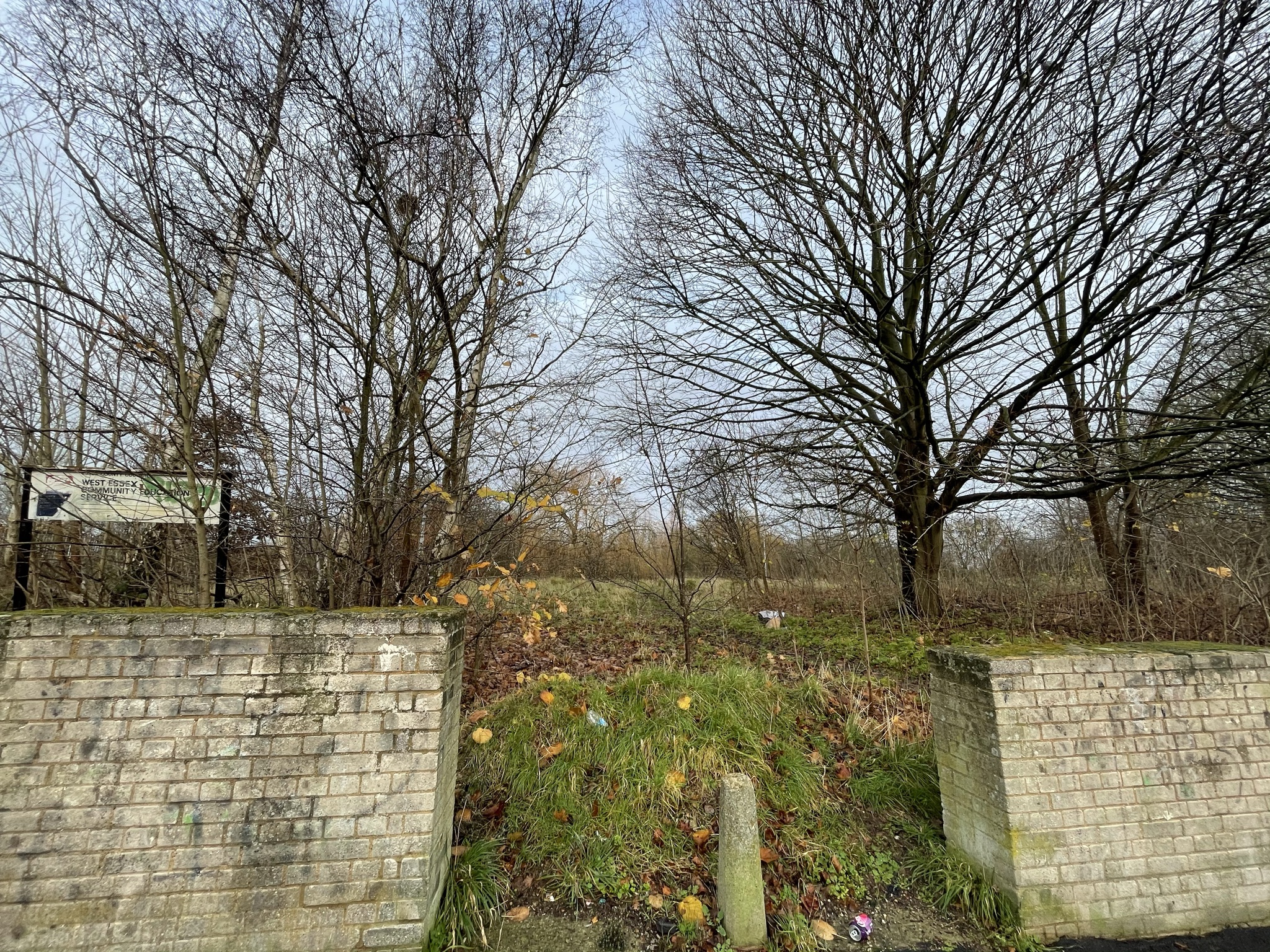
Formerly situated further across to the West on Tendring Road, the site is now flattened and half is lying empty - all that remains is the old concrete foundations, some light standards..


...and the entrance, plus some fencing... 


 There is a “West Essex Community Education Service” sign lurking over to the left hand side there too. The other side of the site is in the process of having the new Sir Frederick Gibberd College built on it - currently looking as though it might just top Passmores on the architecture front. 

The original location of course makes sense of the name of course, being actually in the Passmores area! 

Thursday, 3 December 2020

Bishopsfield

 In 1961 the Harlow Development Corporation held a competition open to all architects for the design of a housing area in the new town - they were looking for something unusual, and different, with the brief being “to solve old problems in a new way” and the design put forward by 24 year old Michael Neylan appeared to fit the idea perfectly. 


Featuring 256 dwellings - a mix of maisonettes and houses, the development is known as “The Kasbah” locally, and even now looks very different to almost anything else in the town. 


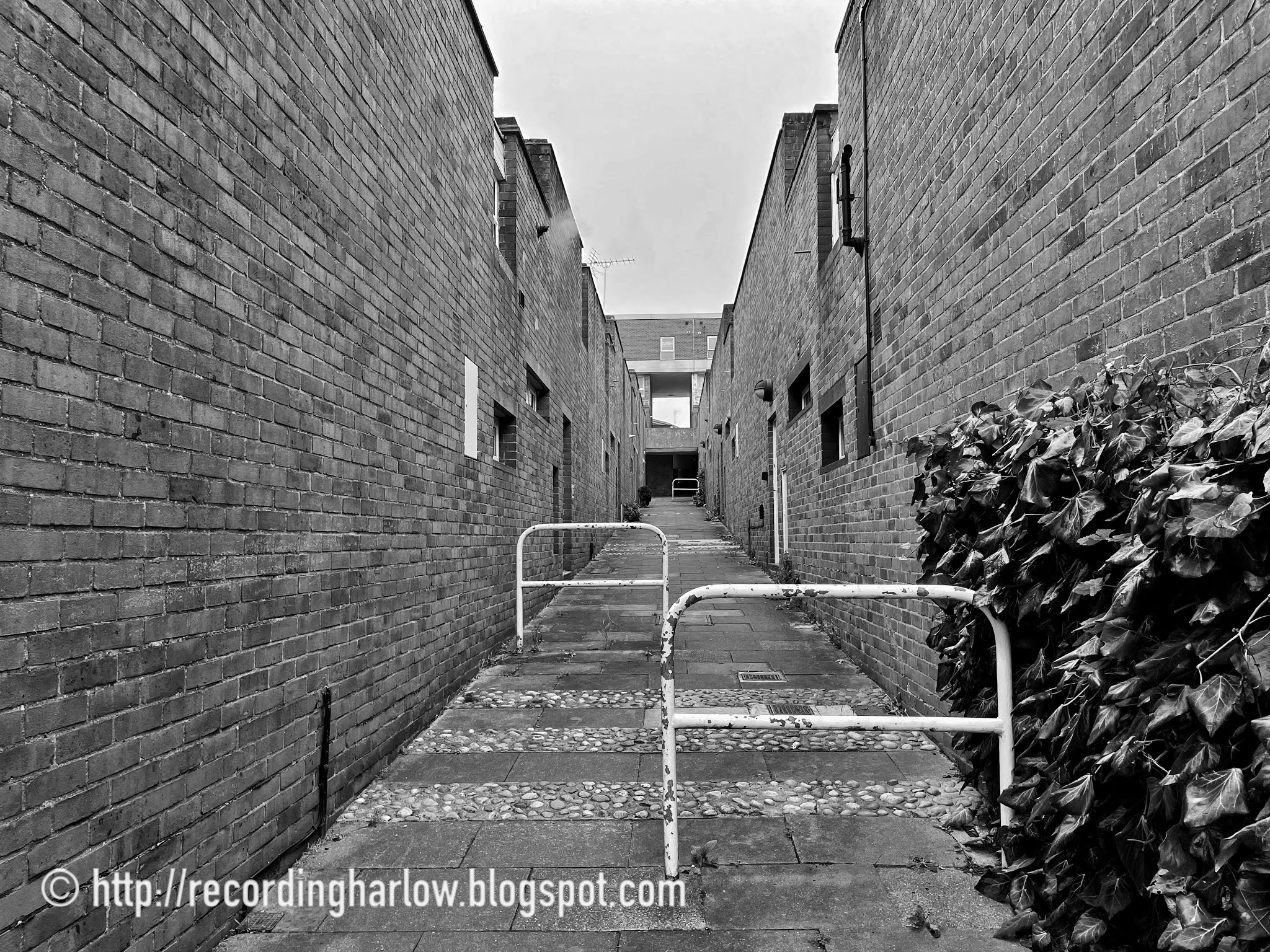
Bishopsfield consists of a horseshoe shaped development with alleyways radiating off it and green spaces between each section. 


Pedestrian walkways are vehicle free - with access being provided via a large open platform leading to a wide walkway accessed via either ramps or stairs. Parking was originally provided via garages tucked away beneath the blocks, but has now unsurprisingly spilled over into the street also. 


Beyond the 5 main blocks forming the horseshoe, the majority of the properties are built on a “back-to-back” pattern, with an L shaped design surrounding a courtyard style garden giving a great deal of privacy - the aim here was to achieve an almost Mediterranean feel. 


Bishopsfield was awarded a Civic Trust Award in 1968, and Housing Design Award a year later. 


Tuesday, 1 December 2020

Sculpture trail... (1)

During the first lockdown, we began the long overdue mission of finding and photographing as many as possible of the town’s many Sculptures. Although we’ve looked at a few of them before, and there is even an earlier post on here about Harlow’s Sculpture Town Status we had never actually attempted to walk the trail. 

We ticked them off on groups - taking an area at a time, walking to it, finding all the sculptures in that area, then moving on to the next area the next time we went out with this particular task in mind. For the purpose of these posts through, I’ll post in trail order. 

No. 1 - Cat - unable to access as inside the Civic Centre.

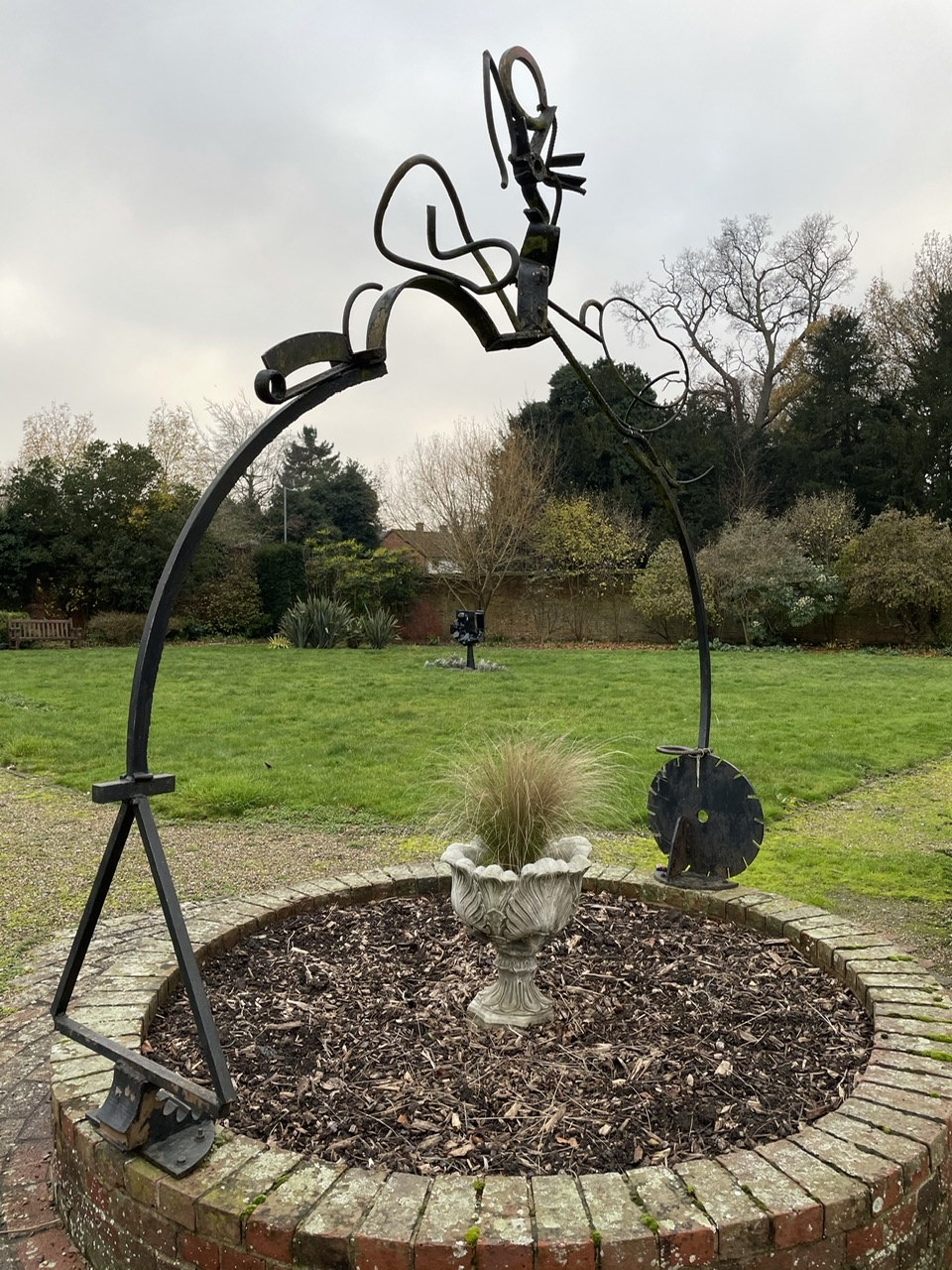
No. 2 - Well Head - Museum Gardens - finally got to this one last weekend...


No. 3 - Stone seat - Museum Gardens as above. 


No. 4 - Butterfly - Newstead Way, Fifth Avenue Development


No. 5 - Sophrosyne - The Chase, Newhall


No. 6 - Madonna & Child - unable to access - inside St Paul’s Church. 

No. 7 - Organic Farm - Fifth Avenue Development but we were unable to locate.

No. 8 - Energise - Harlow Leisurezone


No. 9 - Soldier Bending a Bow - unable to access - inside The Playhouse Theatre

No. 10 - Echo - Southern Way

To be continued... 

(All photos copyright www.photozone72.org.uk)

Saturday, 28 November 2020

Harlow Museum Gardens (2)

 A bright spot in the Covid/Lockdown darkness has been the opening, three days a week, of the Museum walled gardens to the public. A beautiful place to visit at any time, it’s somehow all the more special at the moment - when there are less options available to us. I posted about the gardens previously - you can see that post HERE


In that post I referred to the “unusual fruits garden” with its medlars and figs, among other things - the photograph above shows the figs are still prolific, and the same is true of the medlar tree - or “trees” I should say as we spotted another one on this visit.


The gardens currently have one staff gardener, and a handful of volunteers - numbers are being limited by Covid restrictions of course - and they are doing a wonderful job of keeping on top of the work required by gardens of this size. The big job currently is the stripping back of ivy around the tall red brick walls ahead of a structural survey which is needed. 


The 17th Century garden is looking very neat and tidy - look carefully and you can spot one of the Sculpture Trail works in the middle - there are 6 scattered around the gardens, look out for those getting a separate post of their own. 


You can compare this photo with the one in the earlier post - it’s taken from the same viewpoint up on the platform at the end. The planting has filled out in those closest beds in the last 12 years! 

Friday, 27 November 2020

To the river...

 Alongside Harlow’s many green spaces, green wedges and of course the Town Park, we are also bordered along the northern edge by the River Stort - from Harlow Mill to the east through to Parndon Mill on the western side. 


The river is popular with runners, walkers, anglers, birdwatchers and even cyclists - generally managing to amiably share the towpath which runs on the north bank as far as Terling’s Park before switching to the opposite side to Burntmill Lane where it crosses back again as it leaves the town. 


Always beautiful - but never more so on a crisp, misty autumn morning with a frost edging everything  in  silver, and the sun just trying to punch through. 


As the “Navigation” designation suggests, this is a river still used regularly by boaters - both the traditional narrowboats and more modern motorised vessels - this morning I saw just one solitary narrow boat, but in a sunny summers day there is a regular stream of traffic using the waterway. 


Wildlife is plentiful - Kingfishers, Warblers, Whitethroats, and Blackcaps can all be found in and around the overhanging vegetation, ducks and rails on the water and various birds of prey and the ever present gulls overhead. Also present are water voles - now quite endangered and always a delight to spot. 


Next time you find yourself fancying a walk somewhere within the town, head downhill and explore the river - as well as the towpath there is also a footpath along a fair amount of the opposite bank accessible from the car park on River Way. The river and its surrounding meadows are also linked with the Town Park via the zigzag bridge, and is just a short stroll from the railway at either end of the town too. 

Tuesday, 24 November 2020

Word of mouth...

Moot House & “Chiron” sculpture

This morning I got the opportunity via a chance encounter to hear some word of mouth local history - so often the best way of learning about a subject. Ironically while I was taking photos for the blog, a chap kindly stopped to avoid walking across in front of me, and we got chatting when I thanked him and explained what I was doing (presumably not too many people take photos of Moot a house at The Stow as he was a little surprised to see what I was doing I think). 

The gentleman concerned moved to the town with his family in 1956, and has lived here ever since - so effectively he’s seen the New Town almost from the start. In that time he said he’s seen a lot of change, and not all of it good! 

I asked him about the common rooms and commented that I was curious about the variation in sizes. He agreed - while some were big enough that dances could be held in them, others like Blackbush Spring are tiny! He told me of the time when while working with his father in a wedding catering business they were booked to cater a reception in the Ladyshot Common Room - one of the few with an upstairs. This particular ‘upstairs’ had a sprung wooden floor which turned out to be surprisingly bouncy - while the rest of the food was being set up as the guests arrived, the floor bounced a little too much sending the wedding cake shooting off to one side all over the table! 

Those in the Mark Hall South area will be familiar with Latton Farm and its resident herd of cows. When my friend of this morning was a lad he worked for a while at the farm, with one of his responsibilities being taking the cows from their barn to the fields further along Latton Street, and occasionally slightly further afield, to the other side of what was then the A11 - now the rather busier A414. He recalled one particular occasion when several of the cows decided to “go rogue” and stroll away from the rest of the herd while part way across - 4 cars were delayed and had to wait while he rounded up the strays, he laughed “imagine what it would be like now - the police would be called and everything!”

Other snippets of history he recounted to me include the time somebody decided to build houses on Ash Tree field, ignoring the fact that it was part of the flood plain. They pressed on in spite of many locals telling them it was a poor idea right until the point where a bulldozer was driven into the field - and promptly sank! Also, the amusement when upon the decision being taken to build a play scheme in the Little Parndon neighbourhood where he grew up, it was decided that a local pond would have to be filled in because it was “too dangerous” to leave it there - he said that he had spent countless hours each summer with friends lying along the branch of a willow that overhung that pond - and nobody ever drowned!

A wonderful chance to hear some great stories about Harlow over the last 60 years! 

Monday, 23 November 2020

Autumn colour and going car-free...

We are very fortunate that "New" Harlow was built around a network of roads that were already there - Latton street, Netteswell Road, Latton Common Road and many others were all closed off to motor vehicles once the New Town was built around them and are now available for safe cycling and walking, meaning that those of us who prefer to leave the car at home where possible have an easy "off grid" way of getting from A to B across the town. I can make my way from home in Mark Hall to the Town Centre barely touching a "normal" road, and to the station in the same way thanks to the Town Park.


Of course at this time of year the pleasure is all the greater as another of the Town Planner's achievements comes into its own with the fantastic colours from all the planting. There surely can’t be a better time for a stroll around Harlow than autumn, when even on a fairly overcast day there is still a stunning array of colour. 

During the first Covid lockdown we did a lot of walking around the old roads - indeed on a few occasions it became a bit of a challenge to see how far we could go using as few roads also used by motor vehicles as possible - and it was surprising how easy it was. I even did one 5 mile run almost entirely on old roads, tracks and footpaths, with only a couple of short sections where I was sharing my space with cars. 


Those who don’t know Harlow often voice the opinion that it’s a real concrete jungle - but mostly nothing could be further from the truth - we all have an abundance of green space right on our doorsteps, and the majority of households have open countryside within a reasonably accessible distance, too. Precisely what Sir Frederick Gibberd intended with his plans for our town! 

Wednesday, 18 November 2020

Common as..

 One of the key tenets in the planning of the new town was a focus on community - for there to be both larger community centres such as Moot House and Tye Green Community Centre, and also smaller neighbourhood “common rooms” where more local get togethers such as coffee mornings or playgroups might take place without people having to travel a huge distance from home. My map from 1964 shows 12 of these dotted around the town and although some have been demolished and built over, many do still remain. 


Churchfields Common Room 

Some of the remaining rooms are still used for various “community” activities - the one above houses a martial arts club now, for example. 

Probably my favourite of those I have seen so far is this rather cute “prefab” style room at Glebelands - numbered 1 on my map and I suspect it may have been the first to be built. I’m not sure whether this one is still in regular use but it’s certainly beautifully cared for! 


Glebelands Common Room 

From the common rooms I have tracked down currently, one notable thing is how different they all are. From the tiny Glebelands one, we move on to the Ladyshot offering - rather larger and grander - and also these days with rather less windows than it was originally built with! (see here: HERE for how it looked when it was first built). 

Ladyshot Common Room with Ralph Brown sculpture

Now the long term home of the Harlow Amateur Boxing club, this is one venue that is in use pretty much 7 days a week, still, a albeit probably not for anything that Sir Frederick Gibberd might have expected! 


Halling Hill Common Room

Finally for this post, a style of building that seems almost more suited to somewhere on the Norfolk coast than a new town in Essex - this granite facing is commonly seen elsewhere in East Anglia. This one looks a little more neglected than most of the others I have seen so far - obviously damp and with quite an air of neglect. I wasn’t able to ascertain whether it is still used at all, or not. 

I also tried to track down one more of the Common rooms before posting this - my map shows one formerly in place at Pipers Hatch for Long Ley - however this appears to have been demolished when the new health centre at Sydenham House was built.