Dedicated to capturing Harlow, in pictures...

Showing posts with label community. Show all posts

Friday, 16 October 2026

Hidden history…


The designers of the New Town were surprisingly perceptive when it came to the needs of those living in flats. I’ve mentioned the pram cupboards before, many of those are still in use across the town. Less often found now are the drying greens though - areas where flat-dwellers could hang their washing outside. This was not an entirely altruistic view of course, before the days of tumble dryers having wet washing lingering about indoors wasn’t good for the buildings or their inhabitants. 


Most of the drying greens have disappeared now - there’s no sign of the one at the flats we used to live in, at Cooks Spinney though, tucked away behind the flats are two unassuming wooden fences, and behind a relatively new gate installed in the first…


Not only a drying area, but one which very much appears to still be in use. 


The second area isn’t in as good a condition and clearly isn’t still used. 


I’m not sure whether there are any others of these areas still in use at other flats in the town - I’m not aware of any, but will start keeping a closer eye out as we’re out and about to see. I love that this bit of social history survives though - over 70 years of (mostly) women pegging their laundry out, chatting and putting the world to rights. A meeting place as well as a functional one. 


Thursday, 3 December 2020

Bishopsfield

 In 1961 the Harlow Development Corporation held a competition open to all architects for the design of a housing area in the new town - they were looking for something unusual, and different, with the brief being “to solve old problems in a new way” and the design put forward by 24 year old Michael Neylan appeared to fit the idea perfectly. 


Featuring 256 dwellings - a mix of maisonettes and houses, the development is known as “The Kasbah” locally, and even now looks very different to almost anything else in the town. 


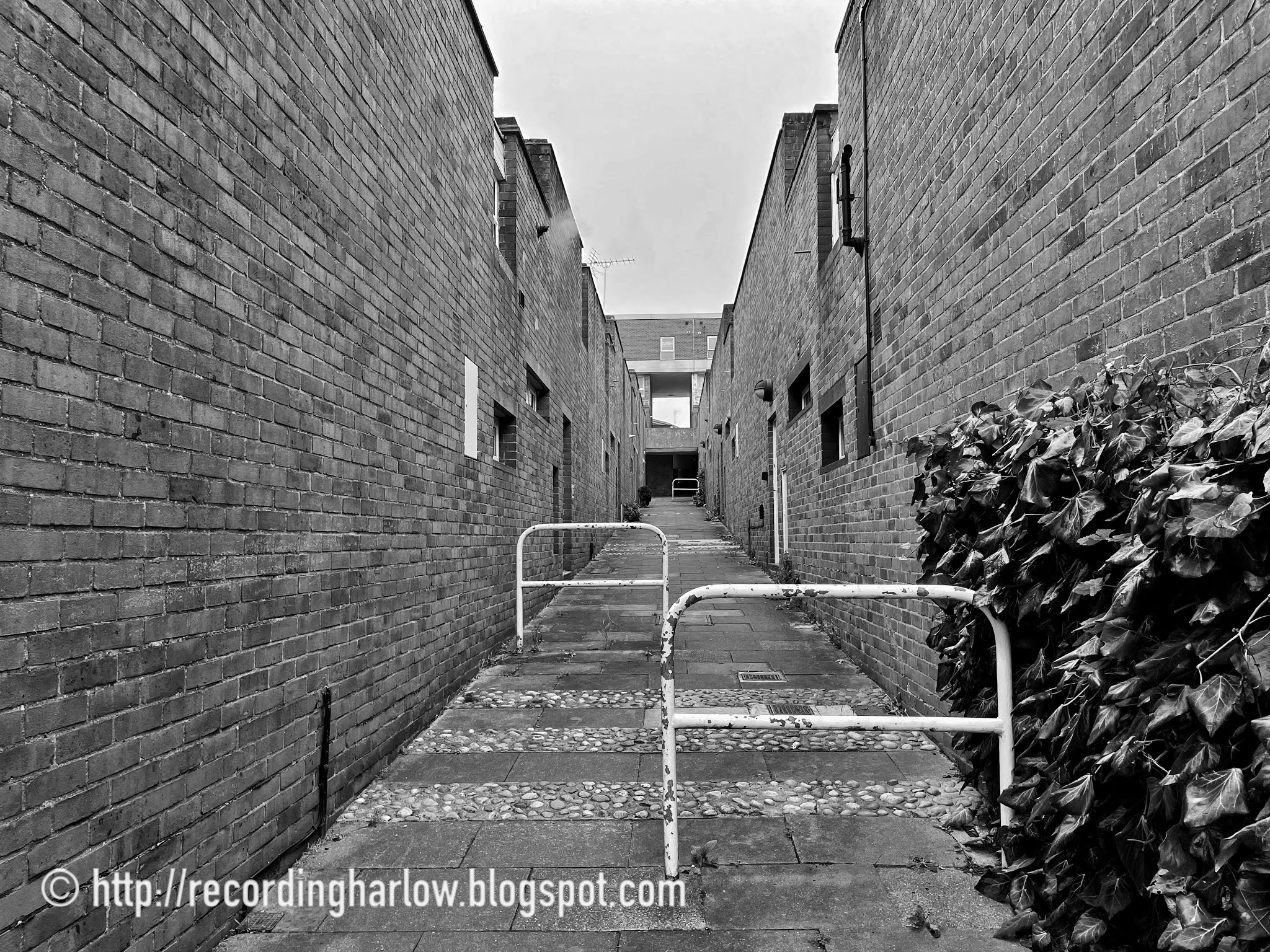
Bishopsfield consists of a horseshoe shaped development with alleyways radiating off it and green spaces between each section. 


Pedestrian walkways are vehicle free - with access being provided via a large open platform leading to a wide walkway accessed via either ramps or stairs. Parking was originally provided via garages tucked away beneath the blocks, but has now unsurprisingly spilled over into the street also. 


Beyond the 5 main blocks forming the horseshoe, the majority of the properties are built on a “back-to-back” pattern, with an L shaped design surrounding a courtyard style garden giving a great deal of privacy - the aim here was to achieve an almost Mediterranean feel. 


Bishopsfield was awarded a Civic Trust Award in 1968, and Housing Design Award a year later. 


Tuesday, 24 November 2020

Word of mouth...

Moot House & “Chiron” sculpture

This morning I got the opportunity via a chance encounter to hear some word of mouth local history - so often the best way of learning about a subject. Ironically while I was taking photos for the blog, a chap kindly stopped to avoid walking across in front of me, and we got chatting when I thanked him and explained what I was doing (presumably not too many people take photos of Moot a house at The Stow as he was a little surprised to see what I was doing I think). 

The gentleman concerned moved to the town with his family in 1956, and has lived here ever since - so effectively he’s seen the New Town almost from the start. In that time he said he’s seen a lot of change, and not all of it good! 

I asked him about the common rooms and commented that I was curious about the variation in sizes. He agreed - while some were big enough that dances could be held in them, others like Blackbush Spring are tiny! He told me of the time when while working with his father in a wedding catering business they were booked to cater a reception in the Ladyshot Common Room - one of the few with an upstairs. This particular ‘upstairs’ had a sprung wooden floor which turned out to be surprisingly bouncy - while the rest of the food was being set up as the guests arrived, the floor bounced a little too much sending the wedding cake shooting off to one side all over the table! 

Those in the Mark Hall South area will be familiar with Latton Farm and its resident herd of cows. When my friend of this morning was a lad he worked for a while at the farm, with one of his responsibilities being taking the cows from their barn to the fields further along Latton Street, and occasionally slightly further afield, to the other side of what was then the A11 - now the rather busier A414. He recalled one particular occasion when several of the cows decided to “go rogue” and stroll away from the rest of the herd while part way across - 4 cars were delayed and had to wait while he rounded up the strays, he laughed “imagine what it would be like now - the police would be called and everything!”

Other snippets of history he recounted to me include the time somebody decided to build houses on Ash Tree field, ignoring the fact that it was part of the flood plain. They pressed on in spite of many locals telling them it was a poor idea right until the point where a bulldozer was driven into the field - and promptly sank! Also, the amusement when upon the decision being taken to build a play scheme in the Little Parndon neighbourhood where he grew up, it was decided that a local pond would have to be filled in because it was “too dangerous” to leave it there - he said that he had spent countless hours each summer with friends lying along the branch of a willow that overhung that pond - and nobody ever drowned!

A wonderful chance to hear some great stories about Harlow over the last 60 years! 

Wednesday, 18 November 2020

Common as..

 One of the key tenets in the planning of the new town was a focus on community - for there to be both larger community centres such as Moot House and Tye Green Community Centre, and also smaller neighbourhood “common rooms” where more local get togethers such as coffee mornings or playgroups might take place without people having to travel a huge distance from home. My map from 1964 shows 12 of these dotted around the town and although some have been demolished and built over, many do still remain. 


Churchfields Common Room 

Some of the remaining rooms are still used for various “community” activities - the one above houses a martial arts club now, for example. 

Probably my favourite of those I have seen so far is this rather cute “prefab” style room at Glebelands - numbered 1 on my map and I suspect it may have been the first to be built. I’m not sure whether this one is still in regular use but it’s certainly beautifully cared for! 


Glebelands Common Room 

From the common rooms I have tracked down currently, one notable thing is how different they all are. From the tiny Glebelands one, we move on to the Ladyshot offering - rather larger and grander - and also these days with rather less windows than it was originally built with! (see here: HERE for how it looked when it was first built). 

Ladyshot Common Room with Ralph Brown sculpture

Now the long term home of the Harlow Amateur Boxing club, this is one venue that is in use pretty much 7 days a week, still, a albeit probably not for anything that Sir Frederick Gibberd might have expected! 


Halling Hill Common Room

Finally for this post, a style of building that seems almost more suited to somewhere on the Norfolk coast than a new town in Essex - this granite facing is commonly seen elsewhere in East Anglia. This one looks a little more neglected than most of the others I have seen so far - obviously damp and with quite an air of neglect. I wasn’t able to ascertain whether it is still used at all, or not. 

I also tried to track down one more of the Common rooms before posting this - my map shows one formerly in place at Pipers Hatch for Long Ley - however this appears to have been demolished when the new health centre at Sydenham House was built.